
Did you know most companies have no policy addressing the use of smart glasses in the workplace? Well, we didn’t either!
Let us state first, smart glasses are not inherently “good” or “bad.” Like many workplace technologies, they can be used responsibly. The question before artificial intelligence (AI) and privacy teams is not whether employees will use them, because they will. The question is whether organizations should act now to set clear guardrails.
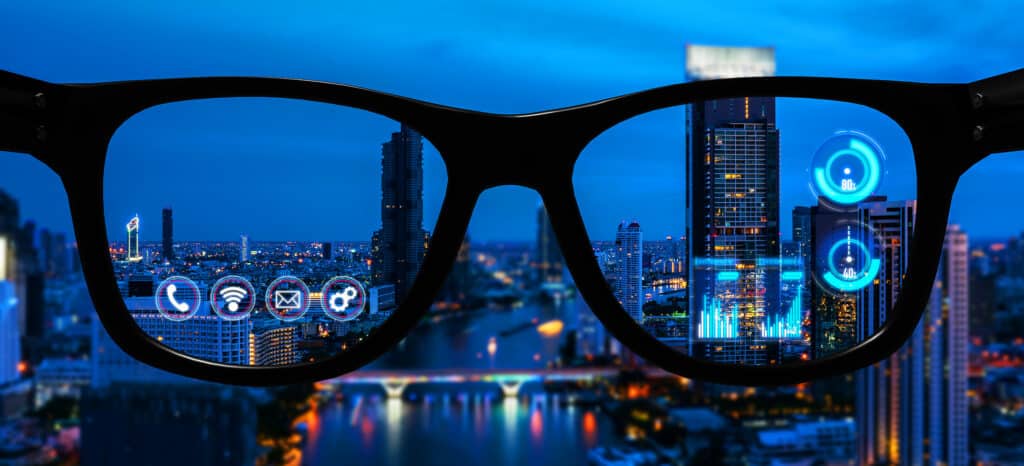
Smart glasses are regular-looking eyewear equipped with built-in technology like open-ear audio speakers, microphones, cameras for point-of-view capture, and transparent heads-up displays (HUDs). They let you listen to music, take phone calls, record video, or view digital information hands-free without pulling out your phone. And here’s the catch – they look like normal glasses!
Is the Time Now?
Yes. The reason for addressing the risk presented by this new technology is simple: smart glasses are starting to cross the line from novelty to norm. Some models can capture audio and video, take photos and even live stream. Even if your employees are not broadly using smart glasses, one person using them improperly can create security concerns.
Recording-free zones
Companies should set a rule that certain spaces are off-limits. A policy should prohibit recording or live streaming in restrooms and any space where individuals have an expectation of privacy. The same restriction should apply to conference rooms during meetings, such as leadership sessions and human resources (HR) discussions. Recording should also be prohibited in areas where sensitive data is displayed. Companies may also want to post signage in certain areas stating that recording is prohibited.
Establish Clear Requirements
In many U.S. states, laws require notifying individuals regarding audio recordings and obtaining consent. It’s advisable that companies have a policy establishing a single workplace standard across jurisdictions that reduces legal risk by having employees provide notice and ask for consent to record with smart glasses.
Protect Confidential Information
Smart glasses can capture video and audio with minimal visibility. Policies should treat this as a data life cycle problem, providing guardrails not just at the moment of capturing data but what happens afterward with the data such as where it is stored and who can access it.
Policies should require employees to “stop recording immediately” if confidential material is inadvertently captured outside the company networks and report the incident through the appropriate channel. The policy should state clearly that unauthorized recording or disclosure of confidential information may result in discipline, including termination.
Address Objections
A good policy anticipates situations such as when someone objects to being recorded, or a situation arises when an employee is recording a one-on-one meeting when there is no need. A good policy gives employees a consistent playbook to handle objections. In jurisdictions where all-party consent is required, recording generally cannot proceed without consent. Companies should offer alternatives such as written summaries or an unrecorded meeting.
Companies should also be clear that objections will not automatically stop a recording. The policy should identify business necessity such as workplace investigations or compliance documentation. Employees should understand these exceptions and that invoking an objection will not necessarily result in recording being paused.
The company’s goal should be to treat employees consistently. If managers allow recording in some situations but not others, the policy becomes harder to enforce. For consistency, companies should create a clear escalation path before conflicts arise.
A different challenge arises when an employee wants to record a meeting and the company objects. Overly broad bans on all workplace recording by a company can create legal risks, including in contexts where employees may be documenting unsafe workplace conditions.
None of this policy works without trained managers. Companies should train managers on when recording are permitted and how to respond to objections.
Accommodation Exceptions
Policies should account for employees who request smart glasses as part of a disability accommodation. Wearable technology is increasingly used as assistive technology, including for hearing assistance. A policy should direct employees to HR to request an accommodation. Like all processes, HR should evaluate the request individually and document the decision. What is unique is that HR may need to work with IT and security to implement safeguards when accommodations are granted.
What About a Total Ban?
Many companies will want to ban smart glasses outright. In sensitive environments, such as schools, hospitals or other sites with children or vulnerable populations, companies may decide a total ban is the right call. In other workplaces, the answer around governance is more nuanced and should depend on the business model.
Today, smart glasses may feel intrusive. That reaction will not necessarily last. What once felt uncomfortable can become normalized. As the technology becomes less visible and more integrated, expectations will shift. That makes early policy-setting critical. Waiting until smart glasses feel normal almost guarantees the devices will already be embedded in the daily workday. Smart glasses may already be in your building, and so should your policy.
The information and opinions expressed are for educational purposes only and are based on current practice, industry-related knowledge and business expertise. The information provided shall not be construed as legal advice, express or implied.